
CONTEMPORARY ART IN A RURAL SETTING
Japan's Second Echigo-Tsumari Triennial: Linking art with the environment and involving local communities
by Robert J. Fouser
The Echigo-Tsumari Triennial is unique among the many biennials and triennials that have become routine in the art world. Held in Echigo-Tsumari, the prosperous rice- and buckwheat-growing regions of Niigata Prefecture, northeast of Tokyo, the triennial takes art out of its traditional urban habitat and sets it in the forgotten spaces of contemporary life: country towns and rural villages. The Second Echigo-Tsumari Triennial, held from July 20 to September 7, 2003, offered a rare look at the fringes of contemporary Japanese art. Of the 157 artists, art groups, architects, and art-student groups, known as "seminars," from 23 countries, most were from Japan.
Most works were placed in Tokamachi and Matsudai, the two small commercial centers in the region, but some works were placed in remote rural sites scattered across the 294-square-mile
 |
area, which has a population of 76,000. The administrative and information center of the triennial was the Echigo-Tsumari Exchange Center, a new art venue in Tokamachi especially designed to host the second and future triennials. The Snow Country Agrarian Culture Center (designed by MVRDV, a team of Dutch architects) in Matsudai and the Museum of Natural Science in Matsunoyama served as subcenters for the triennial. All other exhibition venues were existing sites, such as stores, houses, public buildings, vacant lots, and rice fields. |
|
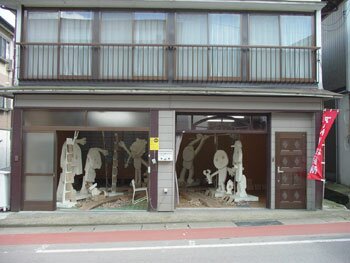
Fukushima University Hiroshi Arai Seminar
Going into the World of Picture Diary, Dear Summer Vacation to Everyone 2003, installation in store, wood, paint |
The construction of buildings for the Second Triennial shows the event is taking hold in the region. The First Triennial, in 2000, was not closely connected with the local community. Many of the artists were from overseas, and most of the art in the towns was conventional public-art sculpture that was part of the Echigo-Tsumari Art Necklace Project, the forerunner of the First Triennial. The dissonance between cutting-edge international art and the local community gave the event a disjointed feeling. Rooting the event in the local community and giving it meaning as a venue for the latest contemporary art were the biggest challenges for the Second Triennial.
Three years later, the most recent triennial made dramatic progress in linking itself to the local community: In 2000, only two community groups participated in the event, whereas fifty participated in 2003. The use of stores, houses, and public buildings in Tokamachi and Matsudai would not have been possible without cooperation from the community. In addition to offering space to artists, local residents participated in producing many of the works, either as subjects or assistants. The connection with the local community is critical because the triennial was developed by local governments in the region to provide economic stimulus to an area that, like nearly all rural areas in Japan, is suffering from depopulation and diminished tax revenues as young people head to big cities for work.
The budget pinch may explain the lack of big-name foreign artists compared with the First Triennial. For visitors interested in contemporary Japanese art, however, this brings a refreshing surprise: more new Japanese art. Except for Yayoi Kusama, most of the Japanese artists in the exhibition are little known outside Japan (or inside, for that matter). The relative obscurity of the artists helped turn the triennial into a place for discovery, a function that few biennales or triennales carry out effectively amid the dominance of big-name international artists.
The most interesting works were those in streets of Tokamachi and Matsudai. Like most small towns in rural Japan, Tokamachi is a collection of drab commercial buildings intermingled among densely residential areas. The townscape is one of square concrete boxes popping up from a sea of tile roofs. In Tokamachi, the main shopping street leads to the train station, which links the town to the rest of the world. Beyond the concrete boxes and roofs lie the mountains and rice fields that give the region its livelihood.
 |
 |
|
Mitsuhiro Ikeda
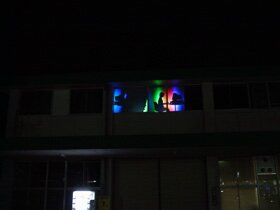
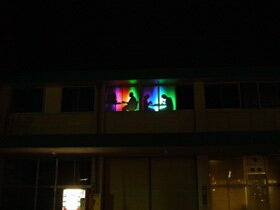
By the Window Tokamachi Version 2003, installation in Tokamachi Station, colored lights, video projectors, workers at train station |
|
Visitors arriving at the Tokamachi station at night were greeted by Mitsuhiro Ikeda's By the Window Tokamachi Version. The work used colored light to project images of workers inside the station onto a second-floor window. The work cast the institutional architecture of the station in a new lightliterallyone with color and movement.
During the day, a walk from the train station along the main commercial streets of town turned up interesting surprises, such as Utility Poles' Clothing Project by Takaaki Fujiki and Fujiki
| Studio KOU::Arc. Located along three streets, the work consisted of utility poles wrapped in bright cloth, which brought color to the concrete and wood streetscape. Aya Tsukioka's Mission "hide-and-seek" GREAT! (in Tokamachi) was on view in a store along a shopping street: the artist had created several kitsch-style goods for the exhibition and sold them in her makeshift store. The most eye-catching item was a kimono patterned with a Coke-can motif, which the artist wore at various events. | 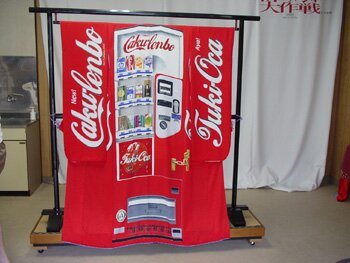 |
|
Aya Tsukioka |
Kimonos were once a thriving industry in Tokamachi, but the industry has all but disappeared. Nearby, an old kimono-cloth mill was reborn as gallery space, displaying the works of four artists. One of the most haunting was Wang Gong Xing's Rice Snow. Placed in a dark tatami room, the work was centered on a mound of rice lit up by a ceiling-mounted video of a moving
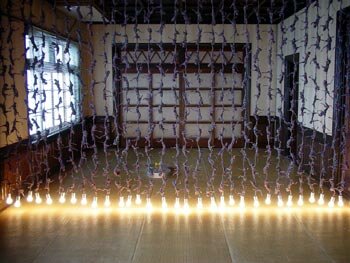 |
hand. Videos of people walking along Tokyo streets illuminated three low tables on which rice was scattered. The work was a poignant reminder of the disconnect between the city and the country that feeds it. Up the stairs was Blood Relative Curtain by Kyotaro Hakamata. Presented in a bright tatami room, the work consisted of electrical wires tied in the shape of people climbing a rope ladder. A row of lights at the bottom brought out the sheen of the old tatami mats. Behind the curtain of dangling lights sat two aluminum disks, one of which was adorned with two lemons. |
|
Kyotaro Hakamata
Blood Relative Curtain 2003, installation in tatami room, electrical wire, light bulbs |
Vacant lots and other empty spaces in town sometimes led to surprises. Kitagawa Takayoshi's Fixation Track was a large flatbed truck filled with soil and planted with weeds and field
| flowers that seemed to "borrow" the scenery of mountains behind and the gravel of a parking lot in front. A Piece of LandBright and Empty by Masao Koizumi and the Tokyo Metropolitan University Koizumi Seminar sat in a vacant lot along the main shopping street. By day, the work was a series of metal poles with plastic drink bottles attached to them, but by night, it became a sea of light when viewers lit it up by calling one of several numbers on their cellular phones. From a distance, the work resembled a forest of bamboo as the poles leaned unevenly against each other. | 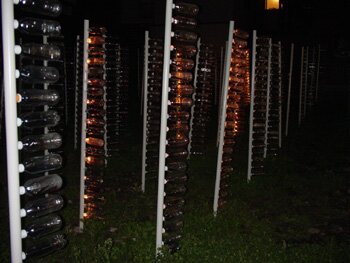 |
|
Masao Koizumi and Tokyo Metropolitan University Koizumi Seminar |
The narrow alleys and spaces in the residential areas of town held some of the most experimental works in the exhibition. Snow in/Snow out by Hisako and Tomoya Sugiwara and their students at Showa Women's University evoked the image of deep snow. White netting
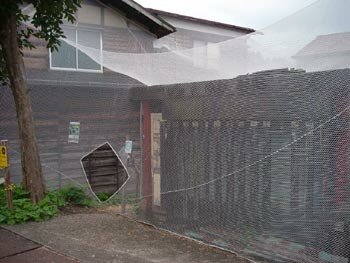 |
was installed over several adjacent old houses; small entryways let viewers enter the netted space between the houses. Shrouded in netting, the space between the houses felt oddly intimate, as it redefined the walls that separate the houses from each other. The same neighborhood was home to Step in/Step out, an abandoned house that was turned into a place of mystery by Atsushi Ogata and C. M. Judge. Using the entire house, the work was built around the sounds of footsteps. The artists took videos of local residents walking in a wide range of settings |
|
Hisako and Tomoya Sugiwara and Showa Women's University Sugiwara Seminar
Snow in/Snow out 2003, old houses, white netting |
The neighborhood was also the site of one of the most restrained works in the exhibition: Crest Home by Masaki Imamura and students from Nihon University. The work used the walls and windows of houses as a backdrop for clear plastic screens on which images of flowers stylized as family crests were stenciled. The screens were composed of long bands of plastic lined up in a row, a design derived from the temporary wooden screens that keep snow out of windows and doors. Like the wrapped utility poles, the plastic screens brought color and playfulness to an aging neighborhood.
Takamachi's Echigo-Tsumari Exchange Center, the administrative headquarters of the triennial, housed several important works. One of the most interesting was Hiroshi Fuji's Kaekko Shop, an installation that was a parody of a toy store and, in fact, doubled as a playroom for children.
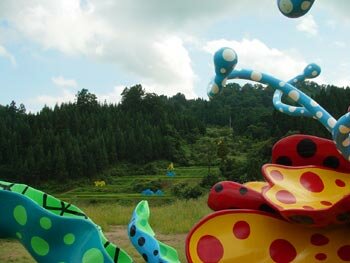
| Matsudai is smaller than Tokamachi, and its busiest shopping street lines the main auto route that runs through town. The scene one encounters outside the train station is an odd mix of pastoral and industrial. As one leaves the station, the new Snow Country Agrarian Culture Center immediately grabs one's attention. Designed as a multipurpose space, during the triennial the center hosted several works, an exhibition shop, and a café. Between the station and the center sat Yayoi Kusama's colorful | 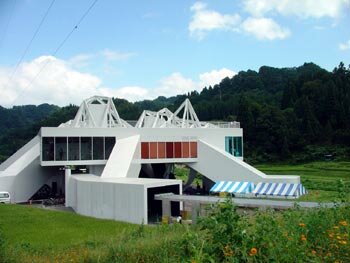 |
|
Snow Country Agrarian Culture Center, 2003, designed by MVRDV |
The highlight of works in the center was Relation-Blackboard Classroom/Relation Farmer's Work by Tatsuo Kawaguchi. The artist turned the center's classroom into an old-fashioned classroom of the sort that would be found in a rural elementary school, but with a twist: all of
 |
the flat surfaces in the room were painted moss green. When opened, each of the desks revealed a computer screen that gave information on the triennial and the center. The uniformity of color and ordered arrangement of objects stood as a metaphor for the conformity of Japanese education, which alienates increasing numbers of young people. The main commercial street in Matsudai contained most of the art-student seminar works. In art schools in Japan, seminars are composed of the third- and |
|
Yayoi Kusama
Blooming in Tsumari (part) 2003, fiberglass and paint (Ilya and Emilia Kabakov's The Rice Field is in the background) |
fourth-year students, many of whom go on to become artists or art teachers (or both). The Fukushima University Hiroshi Arai Seminar's Going into the World of Picture Diary, Dear Summer Vacation to Everyone was one example of a store turned into a temporary gallery space. In a similar vein, students from the Osaka University of Education Kenji Hiroshi Seminar created Chatterbox: A Shop Full of Words in an old hardware store that had gone
| out of business. Many of the remaining objects in the store were painted white, and attached to each were short, nonsensical phrases and questions. The result was an ocean of ghostly white objects that appeared to be channeling to former customers for insight. One of the best examples of a work involving the community was the Joetsu University of Education Toshio Nishimura Seminar's Workshop in Matsudai human-"aida"-place, a cooperative work with children in Matsudai. Town officials allowed | 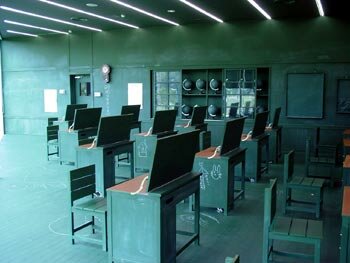 |
|
Tastuo Kawaguchi |
The Second Echigo-Tsumari Triennial challenged viewers to think about the relationship between contemporary art and the human and natural environment. Spread across a wide area in the heat of summer, it also challenged viewers physically, as they walked through towns and fields to view the works. The exhibition went beyond the limitations of "ruralesque" beauty and hard-nosed social realism by showing art that grew naturally out of the environment through collaboration with local residents. The result was a series of works that brought home the issues of depopulation, economic decline, and environmental destruction while offering hope of renewal and reconstruction of endangered rural communities. In the end, it was an exhibition about hope for a better future amid the lingering sadness of the present. Perhaps the next triennial, in 2006, will provide an update on progress in turning that hope into reality.
Photographs by Robert J. Fouser
Robert J. Fouser is an associate professor at Kyoto University. He writes frequently on Japanese and Korean art and culture.